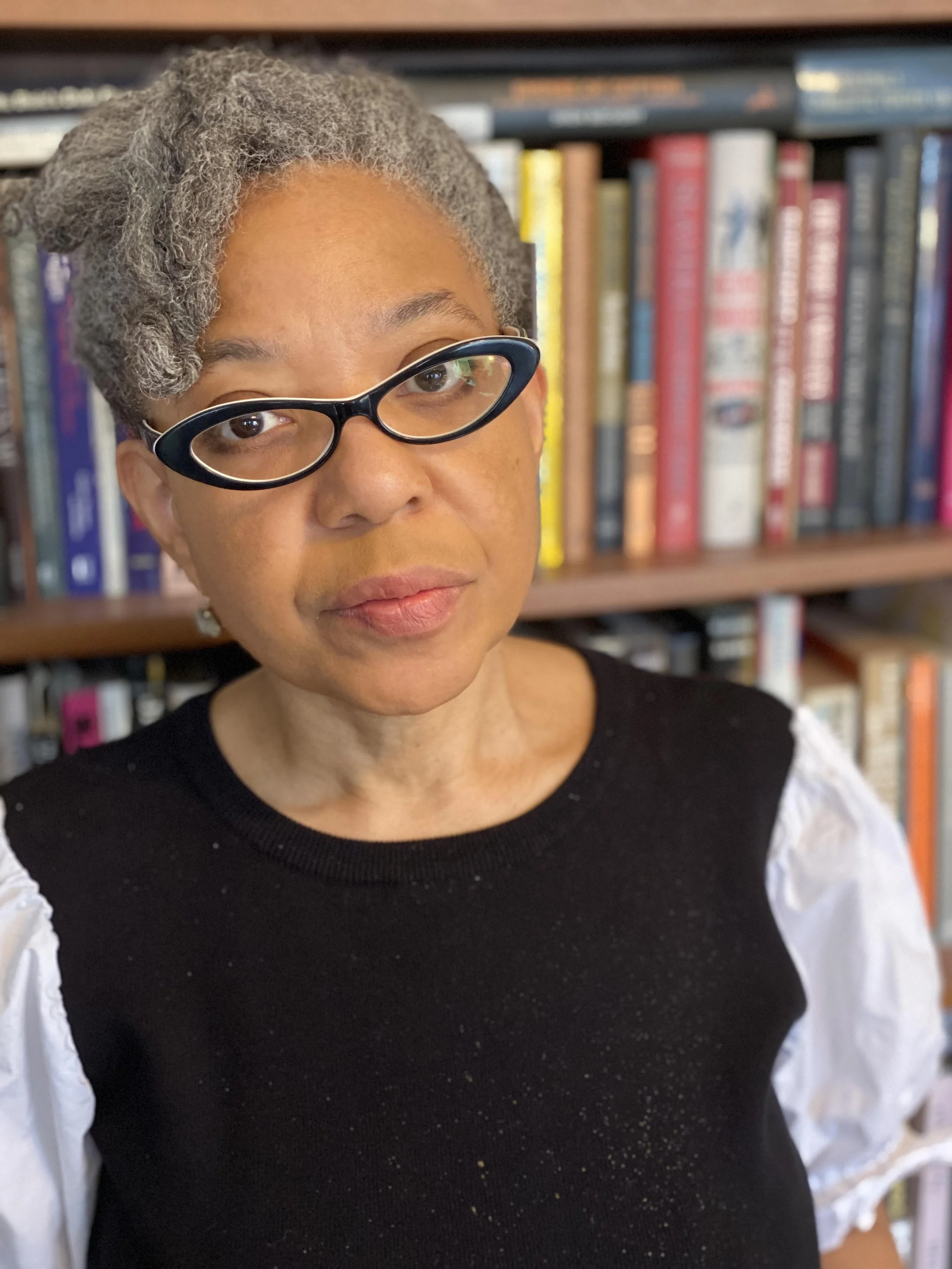
Daphne A. Brooks is William R. Kenan, Jr. Professor of African American Studies, American Studies, Women’s, Gender, and Sexuality Studies, and Music at Yale University. Her writing has appeared in The New York Times, The Nation, The Guardian, Pitchfork.com and other press outlets, and her 2020 New York Times article, “One Hundred Years Ago, ‘Crazy Blues’ Sparked A Revolution for Black Women Fans” was awarded the 2021 ASCAP Deems Taylor/Virgil Thomson Award for outstanding article in the pop music field.
A newly-elected member of the Academy of Arts and Sciences as well as the Society of American Historians, Brooks is the author of Bodies in Dissent: Spectacular Performances of Race and Freedom, 1850-1910 (Durham, NC: Duke UP, 2006), winner of The Errol Hill Award for Outstanding Scholarship on African American Performance from ASTR; Jeff Buckley’s Grace (New York: Continuum, 2005) and Liner Notes for the Revolution: The Intellectual Life of Black Feminist Sound(Harvard University, February 2021).
Brooks has authored numerous articles on race, gender, performance and popular music culture, such as “‘Loud Dreaming’ with Toni Morrison and Cecile McLorin Salvant” in Ways of Hearing: Reflections on Music in 26 Pieces; “Sister, Can You Line It Out?: Zora Neale Hurston & the Sound of Angular Black Womanhood” in Amerikastudien/American Studies, “‘Puzzling the Intervals’: Blind Tom and the Poetics of the Sonic Slave Narrative” in The Oxford Handbook of the African American Slave Narrative, “Nina Simone’s Triple Play” in Callaloo and “‘All That You Can’t Leave Behind’: Surrogation & Black Female Soul Singing in the Age of Catastrophe” in Meridians.
She is also the author of the liner notes for The Complete Tammi Terrell (Universal A&R, 2010) and Take a Look: Aretha Franklin Complete on Columbia (Sony, 2011), each of which has won the ASCAP Deems Taylor Award for outstanding music writing. Her liner notes essays for Prince’s Sign O’ The Times deluxe box set and Omnivore Records reissues of Nina Simone’s early releases on Bethlehem were published in 2020 and 2021, respectively.
Brooks is the editor of The Great Escapes: The Narratives of William Wells Brown, Henry Box Brown, and William Craft (New York: Barnes & Noble Classics, 2007) and The Performing Arts volume of The Black Experience in the Western Hemisphere Series, eds. Howard Dodson and Colin Palmer (New York: Pro-Quest Information & Learning, 2006). From 2016-2018, she served as the co-editor of the 33 1/3 Sound: Short Books About Albums series published by Bloomsbury Press.
She is the co-founder and director of Yale University’s Black Sound & the Archive Working Group, a 320 York Humanities Initiative. https://blacksound.yale.edu/
In Spring 2026, Duke University Press will publish her latest anthology, Blackstar Rising & The Purple Reign: The Sonic Afterlives of David Bowie and Prince, a collection of essays, interviews and lyrical think pieces and featuring over 40 contributions from critics, artists and musicians. The Blackstar Rising & The Purple Reign anthology is culled from an international 3-day conference and concert which she curated.
Edited Works
Blackstar Rising & the Purple Reign: Pop Culture & the Sonic (After)Lives of David Bowie and Prince (Durham, NC: Duke University Press, April 2026)
The Great Escapes: The Narratives of William Wells Brown, Henry Box Brown, and William Craft (New York: Barnes & Noble Classics, 2007).
The Black Performing Arts volume, The Black Experience in the Western Hemisphere, series eds. Howard Dodson and Colin Palmer (New York: Pro-Quest Information & Learning, 2006).
Publications
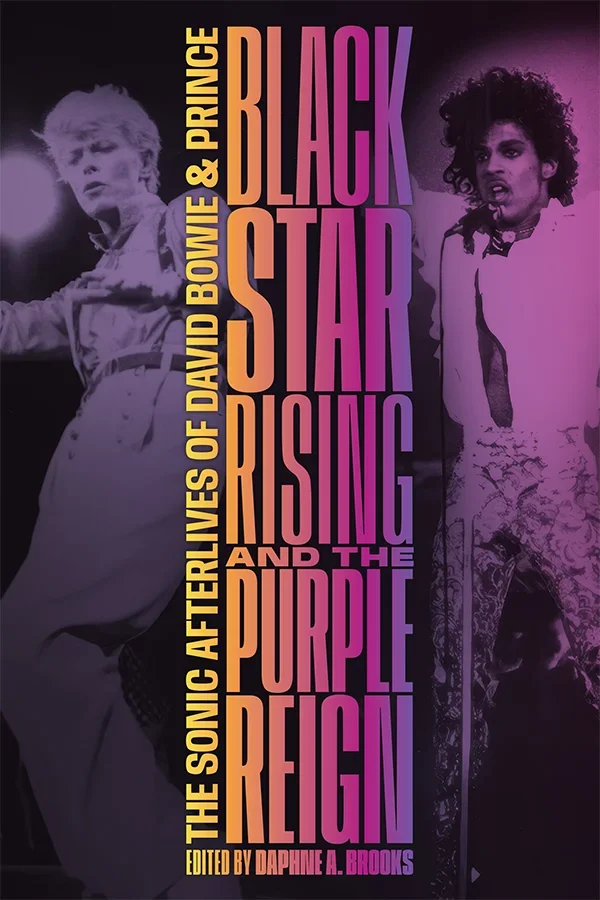
Blackstar Rising and the Purple Reign: The Sonic Afterlives of David Bowie and Prince
Blackstar Rising and the Purple Reign (Duke UP) is the first critical anthology dedicated to the legacies of David Bowie and Prince, edited by Daphne A. Brooks. Bringing together an extraordinary range of scholars, writers, and artists — including Greg Tate, Jack Halberstam, Kara Keeling, Eric Lott, and Ann Powers — the collection examines how both icons reshaped pop culture at the intersections of race, gender, sexuality, and art. Alongside critical essays, the volume features interviews with key collaborators including Sheila E. and D.A. Pennebaker, offering vital insider context to the complexities of their repertoires, politics, and lasting influence.

Liner Notes for the Revolution: The Intellectual Life of Black Feminist Sound (Harvard UP, 2021) How is it possible that iconic artists like Aretha Franklin and Beyoncé can be both at the center and on the fringe of the culture industry? Daphne Brooks explores more than a century of music archives to bring to life the critics, collectors, and listeners who have shaped our perceptions of Black women both on stage and in the recording studio.
Liner Notes for the Revolution offers a startling new perspective, informed by the overlooked contributions of other Black women artists. We discover Zora Neale Hurston as a sound archivist and performer, Lorraine Hansberry as a queer feminist critic of modern culture, and Pauline Hopkins as America’s first Black female cultural commentator. Brooks tackles the complicated racial politics of blues music recording, song collecting, and rock and roll criticism in this long overdue celebration of Black women musicians as radical intellectuals.
Liner Notes for the Revolution: A Landmark Work in Black Feminist Sound
Praise for Liner Notes for the Revolution: The Intellectual Life of Black Feminist Sound
“Brooks traces all kinds of lines…inviting voices to talk to one another, seeing what different perspectives can offer, opening up new ways of looking and listening.”
—New York Times
“A wide-ranging study of Black female artists, from elders like Bessie Smith and Ethel Waters to Beyoncé and Janelle Monáe…Connecting the sonic worlds of Black female mythmakers and truth-tellers.”
—Rolling Stone
“A gloriously polyphonic book.”
—Margo Jefferson, author of Negroland
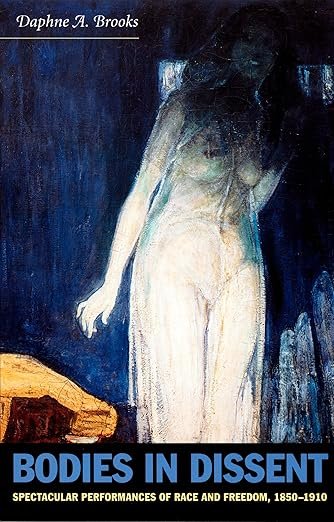
Bodies in Dissent: Spectacular Performances of Race and Freedom, 1850-1910 (Durham, NC: Duke UP, 2006)
In Bodies in Dissent Daphne A. Brooks argues that from the mid-nineteenth century to the early twentieth, black transatlantic activists, actors, singers, and other entertainers frequently transformed the alienating conditions of social and political marginalization into modes of self-actualization through performance. Brooks considers the work of African American, Anglo, and racially ambiguous performers in a range of popular entertainment, including racial melodrama, spectacular theatre, moving panorama exhibitions, Pan-Africanist musicals, Victorian magic shows, religious and secular song, spiritualism, and dance. She describes how these entertainers experimented with different ways of presenting their bodies in public—through dress, movement, and theatrical technologies—to defamiliarize the spectacle of “blackness” in the transatlantic imaginary.
Brooks pieces together reviews, letters, playbills, fiction, and biography in order to reconstruct not only the contexts of African American performance but also the reception of the stagings of “bodily insurgency” which she examines. Throughout the book, she juxtaposes unlikely texts and entertainers in order to illuminate the complicated transatlantic cultural landscape in which black performers intervened. She places Adah Isaacs Menken, a star of spectacular theatre, next to Sojourner Truth, showing how both used similar strategies of physical gesture to complicate one-dimensional notions of race and gender. She also considers Henry Box Brown’s public re-enactments of his escape from slavery, the Pan-Africanist discourse of Bert Williams’s and George Walker’s musical In Dahomey (1902–04), and the relationship between gender politics, performance, and New Negro activism in the fiction of the novelist and playwright Pauline Hopkins and the postbellum stage work of the cakewalk dancer and choreographer Aida Overton Walker. Highlighting the integral connections between performance and the construction of racial identities, Brooks provides a nuanced understanding of the vitality, complexity, and influence of black performance in the United States and throughout the black Atlantic.
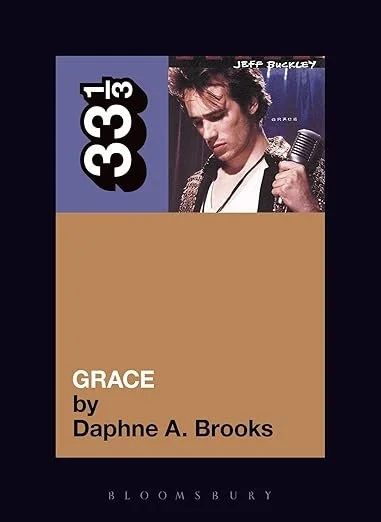
Jeff Buckley's Grace (33 1/3) (New York: Continuum, 2005)
The power and influence of Grace increases with each passing year. Here, Daphne Brooks traces Jeff Buckley's fascinating musical development through the earliest stages of his career, up to the release of the album. With access to rare archival material, Brooks illustrates Buckley's passion for life and hunger for musical knowledge, and shows just why he was such a crucial figure in the American music scene of the 1990s.